Wedding B-list Etiquette

Photo: Timothy Anderson Jr Photography
Somewhere in the last few weeks, you sat down with your guest list and a number from your venue, and the two didn’t match.
So you started a second list. The people you’d love to have if there’s room. And then you felt a little bit awful about it.
Don’t. Almost every couple does this. It has a name — the B-list — and the only reason it feels shameful is that nobody talks about it out loud. So let’s talk about it.
Is it rude to have a wedding B-list?
No. What would be unkind is someone finding out they were on it — and that’s entirely within your control.
There are really only two ways a guest figures it out. Their invitation shows up noticeably later than everyone else’s. Or their RSVP card has a different deadline than the one their friends were talking about. Close those two doors and the whole thing is invisible.
Neither is hard to avoid, and the second one is where most couples slip.
You’re not ranking people. You’re working with a number.
This is where the guilt comes from, so it’s worth sitting with.
A guest list feels like a ranking of who you love. It isn’t. Your venue holds a specific number of people and your caterer prices by the head, and both of those were decided before you wrote a single name down. Every name is a chair, a plate, a linen, a place card.
You’re not deciding who matters. You’re fitting the people you love into a room that has walls.
How big should your wedding be, anyway?
If it helps to know what normal looks like: the average wedding in South Jersey has around 176 guests, according to The Wedding Report.
But averages hide the truth, which is that most weddings are smaller than that. In the same Wedding Report data, more than four in ten South Jersey weddings have fewer than a hundred guests — the average gets pulled up by a handful of very large celebrations.
So if you’ve been quietly worried that 120 is too small, it isn’t. It’s a completely ordinary, completely lovely South Jersey wedding.
When should you send second-round invitations?
Mail your first round of invitations around twelve weeks out — a little earlier than standard — and then send the second round as declines come in, in small batches, never in one obvious late wave.
The extra few weeks are the whole trick. Invitations usually go out six to eight weeks before a wedding, but that leaves no room for a second round. Mailing at twelve gives you a window.
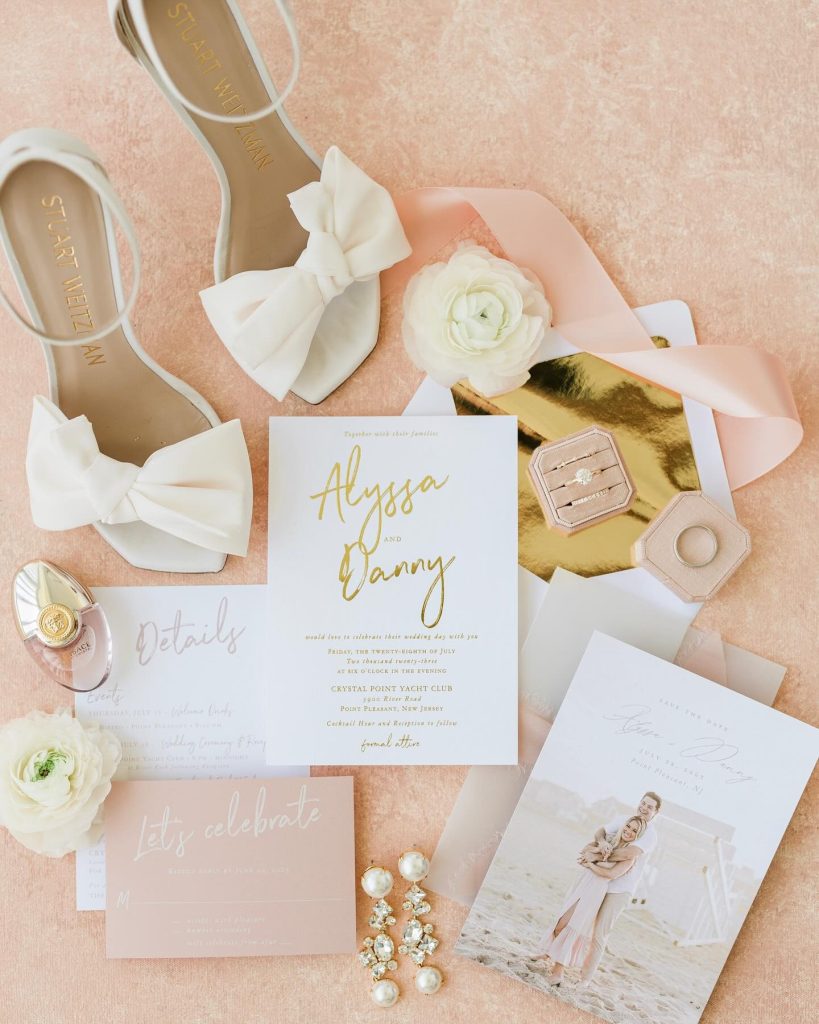
That earlier date also moves your print deadline up, so bring it to your stationer early. Stephanie Somodi Designs is one of the invitation designers we feature in South Jersey.
- Eight months out — save-the-dates, to your first round only
- Twelve weeks out — invitations mail, first round
- Around ten weeks out — the first “we can’t make it” replies arrive, and you begin mailing your second round as they do
- Seven weeks out — the last point a second-round invitation should go out
- Five weeks out — your RSVP deadline, the same printed date on every invitation in both rounds
- Four weeks out — final headcount to your venue /caterer
That seven-week cutoff matters. An invitation arriving any later asks someone to rearrange travel, childcare and time off at short notice, and it reads as an afterthought even when it isn’t.
Save-the-dates are the other half of this. They go only to your first round, because a save-the-date is a promise — which is exactly why your first round should be the list you’re certain about.
The one rule people get wrong
Print the same RSVP date on every single invitation.
It’s tempting to give your second round a later deadline — you’re mailing later, so a later reply date seems logical. Don’t. That mismatched date is the single most common way couples accidentally reveal there was a first round. Guests compare notes. They always compare notes.
How many people should be on your B-list?
Somewhere around ten to fifteen percent of your total count is usually plenty. Build it in small groups of about five, work down from the top as seats open, and stop the moment you hit your number — even if names are left. That’s a sign your list was honest, not a sign you failed.
Five things that make this painless
- Set your cap before you write any names. The number comes from your venue and your catering minimum. Let it be the villain, not you.
- Think in circles, not individuals. Inviting three from a friend group of four is the version that stings. Whole circles in, whole circles later.
- Same RSVP date on everything. The big one.
- Mail in small batches. Two or three at a time as declines land.
- Tell absolutely no one. Not your maid of honor, not your mother, not the group chat. This is the step couples skip, and it’s the only one that can undo all the others.
And one last thing
Nobody sits at a wedding wondering what round they were invited in. They sit there glad to be there.
The couples who agonize over this are, without exception, the ones who cared enough to think it through.
Frequently asked questions
Is it okay to have a wedding B-list? Yes — almost every couple with a guest limit has one. What matters is how you handle it: use the same RSVP deadline on every invitation, and mail your second round in small batches as declines arrive, so no guest can tell which round they were in.
When do wedding invitations go out? Usually six to eight weeks before the wedding. If you’re running a B-list, mail your first round closer to twelve weeks so there’s room for a second round before your RSVP deadline.
How late is too late to send a wedding invitation? About seven weeks before the wedding. After that, you’re asking someone to rearrange travel, childcare and time off at short notice, and the invitation tends to read as an afterthought.
Should B-list invitations have a later RSVP date? No. A different deadline is the most common way couples accidentally reveal that a B-list existed. Print the same date on every invitation in both rounds.
How many people should be on a wedding B-list? Usually about ten to fifteen percent of your total guest count. Build it in small groups, work down from the top as seats open up, and stop as soon as you reach your number.
Do save-the-dates go to the B-list? No. A save-the-date is a promise. Send those only to the guests you’re certain about — a good reason to make your first round the list you’re sure of.
What’s the average wedding guest count in South Jersey? Around 176 guests, according to The Wedding Report. Most South Jersey weddings are smaller than that, though — more than four in ten have fewer than a hundred guests.